

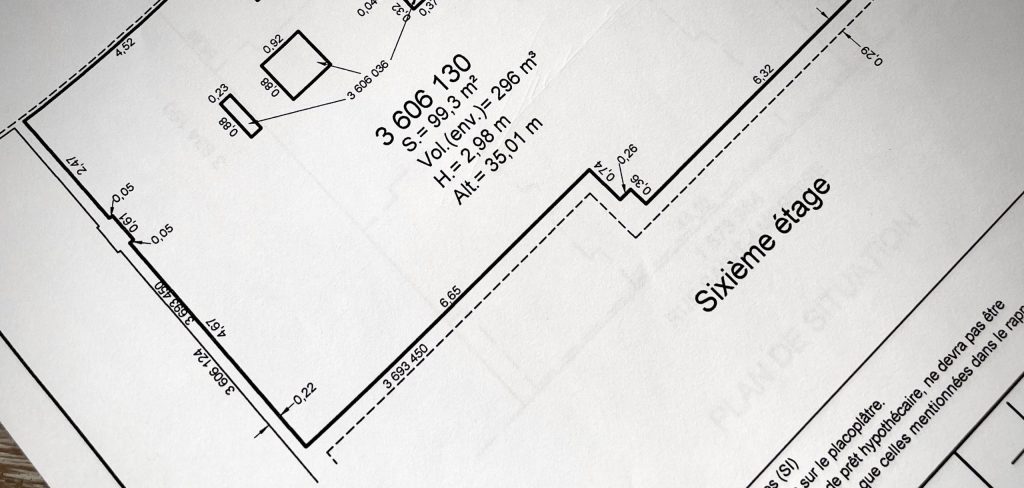
Even if your property is impeccable in every respect thanks to expertly executed renovations, and you’re going to close the deal quickly, it’s important to have a certificate of location. An up-to-date document protects you from costly mistakes.
What does the certificate of location include?
The certificate of location is one of the most important legal documents to have on hand in any real estate transaction, whether it involves a commercial or residential building, a house, a duplex or a condo. In the case of a condominium, the certificate is for the unit only, not for the entire building. If no changes have been made to the property, it is valid for 10 years.
This document, prepared by a land surveyor duly accredited by the Ordre des arpenteurs-géomètres du Québec, essentially consists of a report and a plan in which the land surveyor expresses his or her opinion on the situation and current state of a property in relation to titles, the cadastre, occupancy and the laws and regulations that may affect it.
Signing the promise to purchase
“The certificate of location should be ordered as soon as possible when you know you’re planning to put your property up for sale and any exterior renovations have already been completed, such as extending a terrace or balcony, for example,” explains Katia Samson, founder of Groupe Immobilier Katia Samson and a broker with over 25 years’ experience in Griffintown and southwest Montreal. “That way, if there are adjustments to be made later, such as an encroachment on the neighboring property, we’ll have enough time to correct them.”
Indeed, if the certificate is not up to date and the promise to purchase has to be notarized within 30 days, the delay in the transaction could incur additional costs linked to the faster production of the document in question.
If it turns out that the certificate shows the presence of servitudes or an encroachment on the neighboring property, the signing of the deed of sale will also have to be delayed until the title to the property describes exactly what is included in the sale. The buyer also has the option of withdrawing from the sale.
If there are any irregularities, the seller must take out title insurance. This can cost anywhere from a thousand dollars to several thousand, depending on the size of the transaction.
“These are situations that can potentially add significant costs to the transaction, and that can be avoided if you take action in advance,” emphasizes Katia. All the more reason to make sure you have an up-to-date certificate of location before putting up your “for sale” sign on a property.